4th conference
Our fourth conference of the season, L’archive à l’œuvre : Temporal Fragmentation and Telepathy as Critical Methods, will take place on January 21 at the Clark Center at 5:30 p.m.
History, memory, and fiction: the temporal layers of Mokri's cinema
Shahram Mokri’s films explore the links between time, history, and narrative through a cinematic aesthetic in which memory, fiction, and reality intertwine. This presentation draws on a selection of his works, Careless Crime (2020) and Fish and Cat (2013), to explore how Mokri stages forms of historical representation and an aesthetic of the archive. Far from adopting a linear narrative, Mokri constructs his stories on overlapping temporalities: echoes of the past permeate the present, fictional narratives merge with historical facts, and the cinematic gesture itself becomes a form of reconstruction. This play on temporal layers blurs the boundaries between document and imagination, inviting us to reflect on how history is produced, transmitted, and reimagined through images.
This paper proposes to read Mokri’s work in light of issues specific to art history and museum studies: how can time be archived? How do spaces of memory, whether architectural, visual, or cinematic, shape our relationship to the past?
Lecture presented in French.
Telepathic Visions: A Psychic Investigation of Queer Hauntings on Canadian Archives
In August 2020, I was chosen as the Long Days Artist-in-Residence at Modern Fuel Artist-Run Centre in Kingston, Ontario to conduct an engagement with their Nan Yeomans Research Library. The library archive compiled ephemera, film, funding budgets, and public documents from artist-run centres across the land we now call Canada, dating back to the beginning of the 1970s and spanning into the 2020s. My residency project, entitled Telepathic Visions, aimed to establish a practical concept of telepathy to parse through queer ephemera, connecting myself with embodied queer histories untapped by the material world of art history’s grip on positivist Western Enlightenment philosophy.
In this curatorial talk titled “Telepathic Visions: A Psychic Investigation of Queer Hauntings in Canadian Archives,” I will draw from my upcoming book chapter in Museum Queeries (Jagiellonian University Press) and explore a methodological framework of telepathy to establish alternative modes of psychic connection within archival spaces. The curatorial aims for the methodology of telepathy are two-fold: to escape the rigid boundaries of commodification and depersonalization in museum collections while simultaneously introducing alternative modes of queer hauntology into the archives and galleries.
Lecture presented in english.Moderator
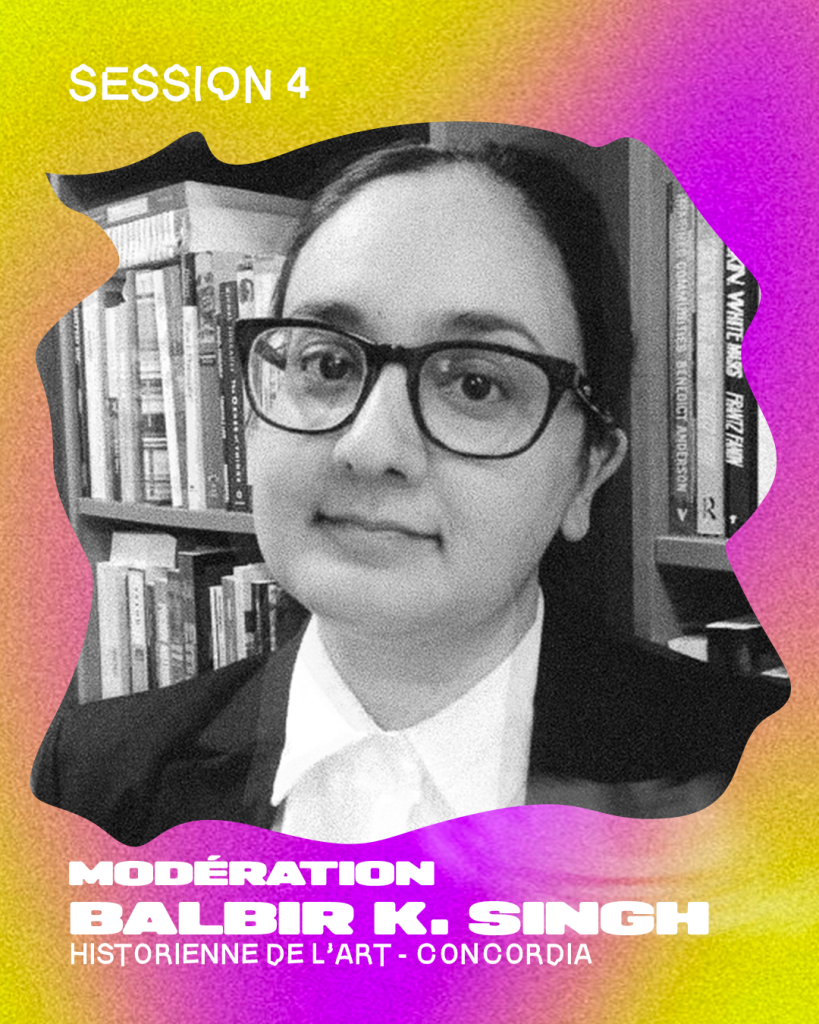
Dr. Balbir K. Singh is Canada Research Chair in Art and Racial Justice, as well as Assistant Professor in the Department of Art History. She is the Director of Dark Opacities Lab, a hub for BIPOC political and aesthetic study and strategy. Recently, she was a Guest Research Associate in the Center for Southeast Asian Studies at Kyoto University, where she worked on the development of the lab’s project, “Nazar: A Theory of the Evil Eye.”